

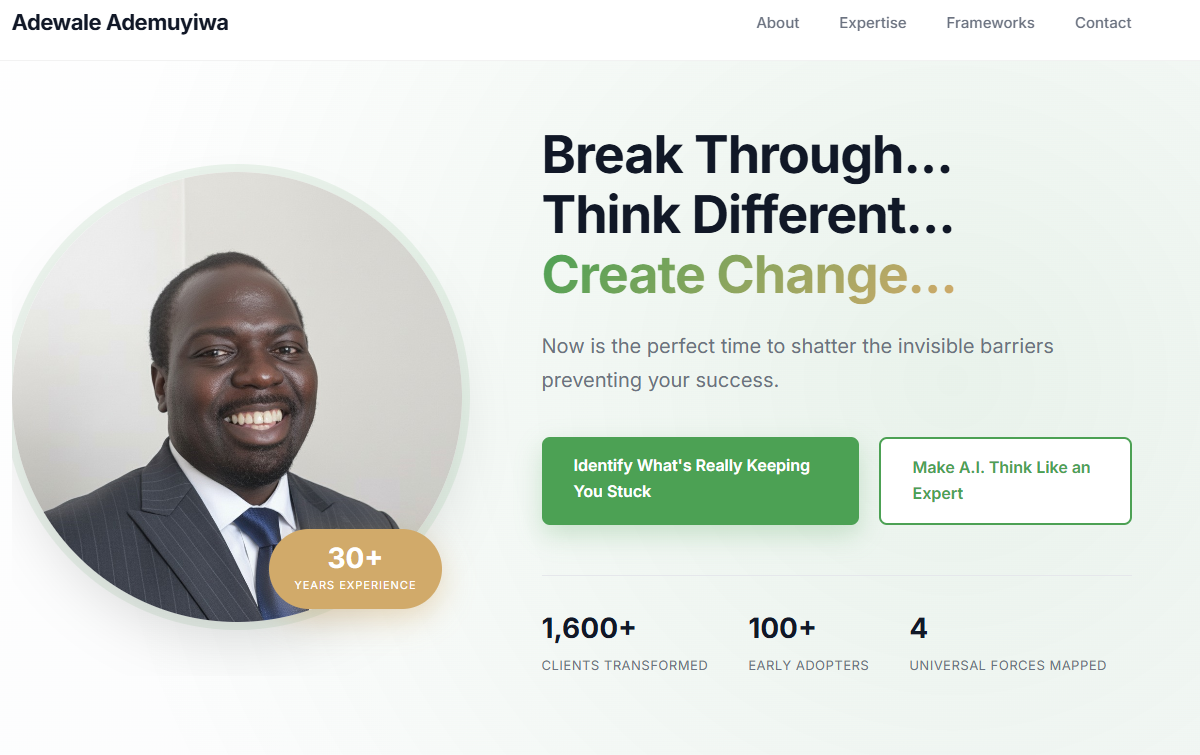
Hi, I'm Adewale Ademuyiwa, founder of Private Content Wizard. I create AI systems for business owners. And over the last five years I've helped over 12,000 small businesses skip months of AI trial and error - so that they can get expert results immediately.
Give me the next 20 minutes and I'll reveal the AI visibility hack that saves business owners £75,000 plus per year, and how you can use this in your business today.
Does This Sound Familiar?
The Revenue Paradox: Making Money But Not Keeping It
Perhaps your business makes a ton of money and revenue is growing... But then so much money is going out that at the end of each month, your bank does not reflect any financial progress.
And if it does, I just want to share something with you.
The Systemic Barrier Theory
Understanding the Two Types of Barriers
If you think of it like there are gaps between what you know and the expertise you need to achieve what you need to do.
The Cooking Analogy: A Simple Example of Expert Knowledge
Let's take a very simple example.
You want to cook a meal, you buy the ingredients and measure properly, but a specific ingredient needs to be measured in a specific way that a chef naturally knows because they've done it over and over again. You lack that expertise, and that small thing makes the whole meal fail.
So for whatever business you are doing, there's market intelligence you haven't learned—these are the external barriers that create a gap. Then there's the internal barriers:
- Psychological experiences like perfectionism that keeps you delaying a launch
- Blind spots where you implement something and things go wrong that you didn't expect
- When that keeps happening, it knocks your confidence
The Downward Spiral: When Confidence and Capacity Collapse
And before long, you feel like giving up because you keep expecting to fail. All of this comes down to not having any capacity. These two forces, the external barrier and the internal barrier, create a system that keeps a person stuck.
The Traditional Solution: Coaching
Why People Turn to Coaches and Programs
So what most people do then is they find a coach or coaching program to help them avoid these mistakes. The coaching program costs almost £2,000 and provides occasional one-to-one support, maybe once a week, plus webinars, videos, and instructions to do things yourself. You'll move faster than someone who doesn't do this at all.
So it's not totally bad. But why could this still be causing you to make costly mistakes?
The Real Economic Reality
The £24,000 Question: What Are You Really Paying?
And this is where the reveal is.
You spend £24,000 per year on coaching fees, plus your implementation time—over 10 hours per week times 48 weeks.
The Hidden Costs Your Coach Can't Prevent
Then there are the blind costs we're not looking into:
- Your coach does not prevent you from hiring the wrong person—someone toxic who works against everything you want to do. That's a blind spot that costs a lot of money
- Your coach doesn't walk through your failed campaigns because they're coaching many people. They won't review each person's campaign mistakes unless you pay exorbitant fees, and only if the coach is well versed in your niche
- Often coaches are versed in generic strategies but can't apply them specifically to your field. So you end up with failed campaigns
When Success Feels Like Failure: The Underperformance Trap
And then after ending up with failed campaigns, the launches that are working are underperforming. Perhaps you make a sale every two months when the coaching program suggested hundreds of sales a year.
The Seven-Figure Illusion: When Revenue Doesn't Equal Wealth
And even if it's not underperforming, you may be making a lot of money, but a lot of these blind costs take money away. You end up in the same situation as someone with a salary, except you've done thousands more hours of work. Seven figures come in and seven figures go out. How much is really available to spend and live on? About the same as someone living off a salary.
So that's the first trap, the real economic reality.
The Four Internal Forces That Destroy Performance
We've touched on this, but I want to really hone in properly into this. These four forces work together to keep you stuck:
- The Emotional Rot - Paying for a Safety Net, Not Knowledge
- The Blind Spots - The Questions You Don't Know to Ask
- The Stuckness - When You Start Doubting Your Own Intelligence
- The Capacity Issue - Complete Emotional Drainage
1. The Emotional Rot
Paying for a Safety Net, Not Knowledge
I know that sounds like a deep word, but look at it this way.
You watch the coach's videos and feel this is valuable stuff you don't want to lose access to. You pay monthly fees to maintain access and feel like you need to check with your coach first for everything. You cannot let go because if you do, you'll make mistakes without access to help.
What this is doing then is it's causing you to not trust your decisions and you end up paying for the safety net, not the knowledge. You become less confident. This emotional rot causes your imposter syndrome to get worse over time.
2. The Blind Spots
The Questions You Don't Know to Ask
Then we've talked about the blind spots already, and the major part this blind spots live in is in that ability to cross you with the things you don't know you don't know. I know that sounds wrong. But the things you don't know you don't know create a problem where you don't even know what questions to ask to resolve the problems. When you don't know there's something you don't know, how are you going to break through that problem?
3. The Stuckness
When You Start Doubting Your Own Intelligence
So by the time you've been impacted heavily by this emotional rot and blind spots, you start feeling stuck. One, you start doubting your intelligence because you wonder why you're cycling through the same situation. You don't even want to try.
And what does that lead to? Your coach tells you to post three times next week or send emails, but you don't do it. Three days, four days, one month, two months, three months pass. Five months later, you think if you'd done it five months ago you would have achieved more, but there's a stuckness going on.
4. The Capacity Issue
Complete Emotional Drainage
And then the final one is the capacity issue.
By the time you've gone through all of this over and over, you're drained. If you're drained, you don't have the energy to carry on.
The Expensive Gap
What Your Coach Can Give You vs. What They Can't
So what are we saying? The coach gives you general principles, proven frameworks, and guidance to implement things, but there's a huge expensive gap.
Because one, there are unknown risks—what could go wrong in your situation? Your coach can't warn you of specific problems you're experiencing or problems you don't know exist, unless they're working with you 24 hours a day or doing the work for you. They can't know the things you come across every day.
The Market Intelligence Gap: What's Happening Right Now
So they don't know what's happening in your market right now. They don't know what your competitors are launching. You can see these things, but your coach won't have this information to give you the intelligence you need. So as a result, your business's unique leverage suffers.
So let's explore how AI can become that visibility system.
AI as a Visibility System
Stop Thinking of AI as a Tool
I want you to stop thinking of AI as a tool and start thinking of it as a visibility system, a system that can make invisible problems visible before they become expensive. I'm going to walk you through some examples of how this can work and I'll show you exactly how you can use this right now.
Key Insight
AI isn't just a tool for automation—it's a visibility system that reveals blind spots before they become expensive mistakes.
Example 1: Building Private Content Wizard
What Is Private Content Wizard?
As an example of an experience I had, I've told you that I build AI systems and one such system I've built is Private Content Wizard. We use core blogging principles and trained my own Gemma AI Humanizer model to sound human in its writing.
The Challenge: No Coding Knowledge, Frontier Technology
The concepts had been developing for a while, but I couldn't make it come into fruition. The idea here is I'm someone who, I have no coding knowledge. Building AI things felt impossible because this is frontier technology. So how would someone who knows nothing about AI learn to build an AI tool?
The Traditional Cost: 4-7 Years and £2 Million in Team Hours
So I used AI. Within three months I created a very powerful system that there would have been no way for me to do otherwise. Just me, within a few months.
The traditional approach would have cost:
- At least four to seven years of training
- Or over £2 million worth of hours from teamwork to do the same thing
- What I built cost me zero pounds
I put in time over three months, but how did I do that without running into problems? And this is where the method I'm teaching you today comes into play.
The Problem with Traditional AI Prompting
Why "Act Like an Expert" Doesn't Work
With AI, usually we tell AI to take on an expert role and leave it at that. "Take on this expert role and give me this solution." But this creates a problem—the AI will only sound like the expert rather than become the expert. AI is not going to take on that persona properly just by telling it to act like an expert.
So the AI sounds like the expert and doesn't really dig into the problem, causing you to experience blind spots you don't know exist. You follow the AI's instruction and get an outcome that almost fits but doesn't properly fit, creating a problem. You could spend months trying to resolve the problem created by the blind spot.
The Solution: First Principles Thinking
Breaking Down to Core Truth
So the solution is to take the expert and ask them to use first principles thinking. First principles thinking is a way to get the AI to ignore all assumptions and go down to the core truth of the information you're analyzing. It breaks everything down to core truth. This causes the AI to reveal blind spots you would not have noticed before.
And that's what helped me build this AI tool. By the time I counted the features in this tool, it was clocking over 2,000 plus different features that there's no way I could have done myself if I didn't use AI to help me understand concepts about LangChain, embedding, all these things I didn't know what they meant before. I got experts in those areas to help me piece the puzzle together. So that's one example.
Example 2: Closing a Sale in 36 Minutes
The Customer Who Started Chasing Me
So the second example here is after showing the video about the group function in my AI tool, one of my customers started emailing me, asking if he could get access to the older tool, and if he buys that, would he get a discount to the new one.
Creating a Multi-Expert AI Team
What I would've done before would have just messaged him, asked questions, and tried to sell the older tool. Usually the sale would fall through. I'd get confused why the sale fell through when this person was chasing me for what he wanted.
But this time, I decided to use the AI experts, right? I created a multi-expert system. I got a sales team together using AI, then a web designer team using AI.
So I created a first principles set of sales experts to analyze the conversation I had with this person. They looked at the customer's psychology—what was happening for the customer. Because if I didn't understand that, my next response could win or lose the client.
So I just copied that in. The AI team analyzed the customer's messages and my interactions, then gave me the exact play-by-play steps. So that was problem one.
Problem Two: No Sales Page Ready
So the second problem was actually I didn't have any sales pages ready. If your initial conversation doesn't break the sale, once the customer gets to the payment page, the content on that page will break the sale. So I didn't want that to happen.
The Result: 36 Minutes From Start to Sale
Now, this whole process took just 36 minutes. They suggested creating a page based on the customer psychology and where he already was in the buying pipeline. I got the AI to build the page.
This whole process took just 36 minutes. This would've taken roughly two to four months and a lot of costs. Here's what I did:
- Read the customer's comment, copied it
- Pasted it into the AI psychology team conversation
- They gave me analysis
- I put that into another conversation with expert AI designers
- They created the HTML code
- I put it up for the customer
- The customer went straight and bought the package
All in 36 minutes.
Alright, so this is what I'm saying in how the system works.
The Four-Step Framework
How the System Actually Works
It's a four step framework:
Step 1: The Expert Persona - Select a specific expert (even when you don't know which one)
Step 2: First Principles Thinking - Move from acting like an expert to becoming one
Step 3: Reveal the Questions - Uncover what you don't know to ask
Step 4: Real Time Implementation - From guidance to done-for-you solutions
1. The Expert Persona
Selecting the Right Expert (Even When You Don't Know Which One)
You're selecting an expert's persona, first of all. Instead of a generic question, ask the AI to act like a specific expert. Sometimes you may not know what expert will work for that question. So you ask the AI: "I have this problem. What experts would work for this problem?" The AI will give you experts that could work and you choose one.
2. First Principles Thinking
From Acting Like an Expert to Becoming One
So once you've got the AI expert, then you ask them to use first principles thinking. This is very crucial. If you don't, the AI will act like the expert, not become the expert. Get the AI to use first principles thinking. Not how do others do this, but what must be true? What's the foundation of that problem? And what that does then, it starts to help you reveal blind spots.
3. Reveal the Questions You Don't Know to Ask
Uncovering Your Blind Spots
You could even ask the question: "What should I be asking that I don't know about in this situation?" Get the AI to help reveal those questions.
4. Real Time Implementation
From Guidance to Done-For-You Solutions
And then the real time implementation. Rather than getting guidance, you could get the AI to implement it for you. Depending on where you are in your ability to use AI, you could get the guidance and do it yourself or get the AI to implement the guidance for you.
So this is a system. It's not something, nothing about luck. It's a system that works every single time for any domain.
Bridging the Knowledge Gap You Didn't Know Existed
And that's the key thing here. Where before you needed to rely on the coach or another expert who was going to charge you £5,000 or £1,000 or £2,000 or £3,000 because there was something you didn't know about, you relied on experts to help you.
What AI has done now is bridging that gap and helping you find ways of getting to the knowledge, the expertise and implementation that you didn't have access to before. I'm hoping that all makes sense.
What This Actually Looks Like
The Wrong Way: Generic AI Prompts
So what does this actually look like?
"AI, help me make a business decision about hiring" fails completely.
The Right Way: Specific, First-Principles Prompts
Now use the system approach: "Act as a business strategist or an organizational psychologist with 20 years of experience." Yes, that could be good, but don't leave it there. Tell the AI what you're considering: "I'm considering hiring a marketing manager, maybe around £45,000 for my business." Then ask the AI to use first principles to analyze these issues, be specific to my business stage and situation.
Real-Time Intelligence at Every Stage
This gives you revelation, real time intelligence for every stage you are in. Instead of going to the coach, getting advice, implementing that advice, then waiting another week or month to see the coach again for the next stage.
Making Problems Visible Before They Become Expensive
Now you get real time instruction for whatever you're doing, and the AI helps you reveal the blind spots and move you forward. And this way you avoid problems by making them visible before they become expensive.
And that's what that statement meant. The best way to avoid problems is to make them visible before they become expensive. AI will help you identify the problem, make it visible and help you prevent them, rather than making you make an expensive mistake, learn from the mistake, then solve the problem.
Your Next Steps
Your 24-Hour Challenge
In the next 24 hours, I would like you to do this. I would like you to take one business decision you are considering, and then you use the AI expert personas like I've explained today to help you figure out the blind spots. Or perhaps think back six months to a business decision you made already.
Calculate Your Costly Mistakes
What did you know? What was it that you did? What did you struggle with that you didn't know, and how much did it cost you?
Look for one mistake:
- Something that delayed you
- A wrong hire you made
- A failed campaign you ran
- Money you spent that didn't work
Share this with me. You can share it in this video or message me and I can help you walk through the experience to see if you're using the system correctly. I can give you advice to help you pinpoint areas where there may be problems.
Stop the Money Leaks in Your Business
So there you have it—how to avoid costly mistakes that could be breaking your business or leaving you with a business that has holes, like baskets shedding loads of money that you don't need to anymore in this AI age.
Action Steps
- Identify one current business decision you're facing
- Apply the four-step framework with AI
- Use first principles thinking to uncover blind spots
- Get real-time implementation guidance
- Calculate how much money this approach could save you


Comments
Leave a Comment